
26 June 2025
Mohamed A Warisay USA
ECOWAS 67th – Increased Credibility Deficit Exposed Following the Selection of Bloodthirsty Illegal President Bio
Quick Summary
Julius Maada Bio’s democratic credentials have raised critical concerns about ECOWAS’ commitment to the very principles it was founded upon.
The recent selection of President Julius Maada Bio of Sierra Leone as the Chairman of the Economic Community of West African States (ECOWAS) has ignited a fierce debate, casting a long shadow over the bloc’s already strained credibility. This appointment, coming amidst serious questions about President Bio’s democratic credentials and governance record, raises critical concerns about ECOWAS’s commitment to the very principles it was founded. (Photo: Bio and Tinubu are birds of the same feathers).
Background to the Formation of ECOWAS
Fifteen West African countries established the Economic Community of West African States (ECOWAS) on May 28, 1975, with the signing of the Treaty of Lagos. Its primary objective was to promote economic integration across the region, fostering cooperation and development among member states. Beyond economic goals, ECOWAS has evolved to play a significant role in maintaining peace and stability, often intervening in political crises and conflicts within the sub-region through initiatives like the ECOWAS Monitoring Group (ECOMOG). The bedrock of ECOWAS’s existence, therefore, lies in fostering not only economic prosperity, but also good governance, democracy, and stability.
President Julius Maada Bio’s political history is deeply intertwined with military interventions. He participated in two coups in Sierra Leone: first in 1992 as a junior officer, and then in 1996, when he briefly served as the military Head of State under the National Provisional Ruling Council (NPRC) before he was forced to transition the country back to civilian rule. While he eventually handed over power, his past involvement in unconstitutional changes of government inherently raises questions about his commitment to democratic norms.
His first five-year term as president, from 2018 to 2023, was met with significant criticism. Despite some claims of progress in the fight against corruption, various reports from watchdog organizations and independent observers painted a picture of widespread corruption, weak checks on the executive, and a lack of transparency.
Allegations of extrajudicial killings and a stifling of peaceful demonstrations have also marred his tenure, indicating a disregard for fundamental human rights and civil liberties. Furthermore, a glaring and persistent issue throughout his presidency has been the government’s inability to provide stable electricity and pipe-borne water to its citizens, even after seven years in power. This fundamental failure in service delivery severely undermines any claims of fostering economic integration or improving the lives of citizens of the region.
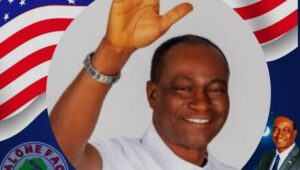
Adding to these concerns, several organizations, notably Africanist Press and various local and international civil society groups, have highlighted a troubling trend of “state capture” under President Bio’s administration. This refers to a situation where the government exerts undue influence over independent institutions, including the press, civil society organizations (CSOs), and other critical oversight bodies. Accusations suggest that these entities are often “bought” or coerced to align with the government’s agenda, effectively buying their silence or compelling them to do the bidding of the government. Such a state of affairs severely cripples democratic accountability and fosters an environment where corruption and human rights abuses can thrive unchecked. (Photo: President-Elect Dr Samura Kamara is confident of winning the battle for the people).
The June 2023 general elections in Sierra Leone, which saw President Bio declared the winner, were widely criticized by international observers for their lack of transparency and credibility. Numerous reports highlighted irregularities in the counting process and concerns about the fairness of the electoral environment. This widespread questioning of the election results by most, if not all, international observers further weakens President Bio’s democratic legitimacy.
In an attempt to address the post-election tensions, an “Agreement for National Unity” was signed, leading to a Tripartite investigation committee. This committee was tasked with reviewing the electoral systems and management bodies and examining the outcome of the 2023 elections.
However, there are strong allegations that President Bio is now attempting to renege on the implementation of the full recommendations stemming from this investigation, despite having signed and accepted the 85 key recommendations. This perceived backtracking undermines the spirit of dialogue and reconciliation that the agreement aimed to achieve.
Adding another layer of concern are strong allegations that President Bio was planning to withdraw Sierra Leone from the ECOWAS bloc. These claims surfaced following recent meetings between the leader of government business in the Sierra Leonean parliament, Hon. Nyuma and some members of the Russian parliament. Such a move, if true, would not only represent a significant blow to ECOWAS’s unity but also highlight a potential shift in geopolitical alliances that could further destabilize the region.
While it was Sierra Leone’s turn to assume the ECOWAS chairmanship in 2024, the fact that President Bio’s re-election in 2023 is still under intense scrutiny should have provided sufficient justification for the bloc to defer Sierra Leone’s chairmanship until the legitimacy of the elections was definitively settled. This failure to uphold democratic standards in its selection process significantly erodes ECOWAS’ standing.
Even more troubling are serious allegations circulating that President Bio used illicit funds to secure the position as ECOWAS Chairman. These allegations point to a connection with Jos Leijdekkers, a notorious drug lord whom President Bio is accused of providing a haven in Sierra Leone. Such a development would expose a deep rot within the regional body, undermining its integrity and transforming it into a platform susceptible to external and illicit influences, rather than a champion of good governance and a power powerhouse to fight transnational crimes. (Photo: ECOWAS President Omar Alieu Touray).

The controversial nature surrounding President Maada Bio’s selection as Chairman of ECOWAS carries significant consequences. How can a leader whose own election remains highly questionable and who has a track record of suppressing dissent and running the country under state capture effectively hold other transitional countries in the region to account for their democratic shortcomings? This appointment severely compromises ECOWAS’s moral authority and its ability to advocate for good governance and democratic principles, which are the bedrock of its formation.
His inability to provide basic services like stable electricity and pipe-borne water in his own country for seven years raises fundamental questions about his capacity to foster economic integration across the region. Economic integration requires stable infrastructure, the rule of law, and a conducive environment for business – all areas where Sierra Leone under Bio’s leadership has demonstrably struggled.
Moreover, allegations of numerous extrajudicial killings under his administration and a consistent refusal to allow peaceful demonstrations paint a stark picture of a leader who does not respect fundamental democratic tenets. Sierra Leoneans widely regarded corruption under Bio’s administration as the worst they have witnessed in the last 40 years. This is underscored by the unconstitutional dismissal of the Auditor General, Lara Taylor-Pearce, and other highly respected professionals in that department, allegedly to cover up corruption at the state house. These actions are in direct contradiction to the democratic values ECOWAS purports to uphold.
Conclusion
The selection of President Julius Maada Bio as Chairman has undeniably deepened ECOWAS’ credibility deficit. By placing a leader with a history of coup involvement, a highly questionable election victory, a poor track record on human rights, allegations of state capture, and significant corruption allegations, compounded by serious allegations of bribery linked to a drug lord, at its helm, ECOWAS has sent a troubling signal. This decision undermines the very principles of good governance and democracy that were meant to be the foundation of the ECOWAS bloc, jeopardizing its effectiveness as a regional body and its ability to promote stability and genuine integration in West Africa.
N/B: By Mohamed A Warisay, Democracy Advocate, USA – June 25th, 2025

Editorial
19 July 2026
ECOWAS Summit Update: Cocaine Bio is Scared of Handing the ECOWAS Chair to Senegal President Faye; Bio Prefers Anglophone to Francophone Successor!
19 July 2026
Commentary
19 July 2026
EBK’s Fake Freedom Won’t Distract EJ Win; His Arrest for Betraying Democracy Looms; Tinubu Happy to See EBK’s Back; Hope He Returns Sooner to Face Citizens
19 July 2026
Other News
29 August 2026
UN Would Be Making the Greatest Blunder If They Allow the Illegal President Bio, Mob Justice Wife & Girls’ Genital Mutilator Fatima Next Month
29 August 2026
Ugandan Ruler Named World’s Youngest Monarch Died at Age 34; Oyo Nyimba Kabamba Iguru Rukidi IV, King of Tooro, was Crowned at 3 Years Old
28 August 2026
Liberia Indicts Bio’s Son-in-Law Bolle Jos & Accomplice Jewel Appears in Monrovia Court; Bio’s Secret Drug Smuggling Exposed in Overseas Flights
28 August 2026