
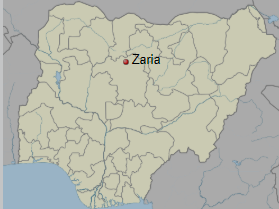
Queen Amina, a Hausa Historical Ruler in the City-State of Zazzau (now Zaria in Kaduna State); First and Only Female to Head National Army
Amina was brought up in her grandfather's court. Favoured by him, he carried her around court and instructed her carefully in political and military matters.
Amina (also Aminatu, born c. 1533; died 1610; pronunciation) was a Hausa historical figure in the city-state of Zazzau (now Zaria in Kaduna State), in what is now the north-west region of Nigeria. Official/palace tradition has her having reigned as queen (sarauniya), however, other traditions say she was a princess (gimbiya). While her name isn’t present on regnal lists found in the Chronicle of Abuja and two published by E. J. Arnett, local traditions say she ruled the territory she conquered. According to some sources, she reigned from 1576–1610.
Early Life
Amina was born in the middle of the sixteenth century CE to King Nikatau, the 22nd ruler of Zazzau, and Queen Bakwa Turunku (r. 1536–c. 1566). (Kaduna State). According to oral legends collected by anthropologist David E. Jones, Amina was brought up in her grandfather’s court and was favored by him. He carried her around court and instructed her carefully in political and military matters. (Photos: Queen Amina ready for war front).
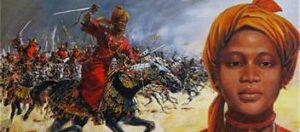


At age 16, Amina was named Magajiya (heir apparent), and was given forty female slaves (kuyanga). From an early age, Amina had several suitors attempt to marry her. Attempts to gain her hand included “a daily offer of ten slaves” from Makama and “fifty male slaves and fifty female slaves as well as fifty bags of white and blue cloth” from the Sarkin Kano.
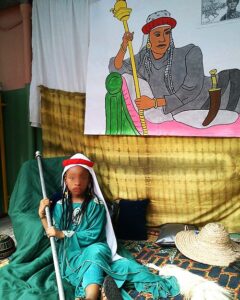
After the death of her parents in or around 1566, Amina’s brother became king of Zazzau. At this point, Amina had distinguished herself as a “leading warrior in her brother’s cavalry” and gained notoriety for her military skills. She is still celebrated today in traditional Hausa praise songs as “Amina daughter of Nikatau, a woman as capable as a man that was able to lead men to war.” (Photos: Amina statue).

Expansion and Dominance
After the death of her brother Karama in 1576, some traditions hold Amina ascended to the position of queen. Zazzau was one of the original seven Hausa States (Hausa Bakwai), the others being Daura, Kano, Gobir, Katsina, Rano, and Garun Gabas. Before Amina assumed the throne, Zazzau was one of the largest of these states. It was also the primary source of slaves that would be sold at the slave markets of Kano and Katsina by Arab merchants. Only three months after being crowned queen, Amina waged a 34-year campaign against her neighbors, to expand Zazzau territory.
Expansion north was blocked by Kano and Katsina, and east by the Jos Plateau; therefore, she campaigned to the southeast and southwest. Her army, consisting of 20,000 foot soldiers and 1,000 cavalry troops, was well trained and fearsome. In fact, one of her first announcements to her people was a call for them to “resharpen their weapons.” She conquered large tracts of land as far as Kwararafa and Nupe, including Bauchi and Yauri. Sokoto caliph Muhammad Bello claimed she reached what presumably was the confluence of the Niger and Benue rivers, and extracted tribute from Katsina and Kano, however, contemporary historians dispute the latter claim. The Chronicle of Abuja says she received 40 eunuchs and 10,000 kola nuts from Nupe’s ruler, introducing these to Hausaland.
Legends cited by Sidney John Hogben say that she took a new lover in every town she went through, each of whom was said to meet the same unfortunate fate in the morning: “her brief bridegroom was beheaded so that none should live to tell the tale.” Under Amina, Zazzau controlled more territory than ever before. To mark and protect her new lands, Amina had her cities surrounded by earthen walls. These walls became commonplace across the nation until the British conquest of Zazzau in 1904, and many of them survive today, known as ganuwar Amina (Amina’s walls).
Death
The exact circumstances of Amina’s death are not known. The nineteenth-century Muslim scholar Dan Tafa says that “She died in a place called Attaagar. It was for this reason that the kingdom of Zazzau was the most extensive among the kingdoms of Hausa, since Bauchi included many regions.” Drawing on Tafa’s account, Sidney John Hogben reports that “Amina died in Atagara, near present-day Idah, for at that time Amina had pushed the frontiers of Zazzau south of the Niger-Benue confluence. But there are many contradictions surrounding her death; many authors in their books cited that she died in Vom Jos while other historians said she died in Atagara, the present-day Idah.” The Oxford Dictionary of African Biography says that, according to tradition, she dominated Hausa land for 34 years and died at Attaagar (likely Idah) in battle, with her body not being recovered. According to one account, Amina was succeeded by her sister, Zaria.
Courtesy: From Wikipedia, the free encyclopaedia

Editorial
6 September 2026
UN Appearance Means Zero; The Bios’ Illegality Remains at the UN; Brutes Like Gaddafi Spoke at the UN; Next Minute He was Killed; Sierra Leoneans, Don’t Worry
6 September 2026
Commentary
6 September 2026
Marathon Race Ends Soon: New ECOWAS President General Diop from Senegal Takes Over from Gambian Traitor Touray; Real Work Began Yesterday
6 September 2026
Other News

6 October 2026
Sanctions on Bio’s Illegality are the Smoke; Hot Fire is Coming to Burn Rights Abusers, Electoral Thieves & Drug Traffickers; Smile Awaits 2023 Voters

5 October 2026
ECOWAS Forces to Deploy in Sierra Leone for Democracy as AU and Regional Blocs Sign the Historic Memorandum of Understanding in Egypt; Happy Times
3 October 2026
Hatred Replaces Welfare Ministry: Bio Prefers Chubby Jos, Running a €1Billion Drug Empire, to the Welfare of Citizens; Restoring Democracy is Only Solution

2 October 2026