2 December 2023
a press release
Millennium Challenge Corporation MCC Will Not Fund Bio’s Illegal Regime After US Foreign Committee Objects
Quick Summary
The reputation of the Millennium Challenge Corporation MCC is at risk if it decides to finance the illegitimate SLPP regime of Julius Maada Bio.
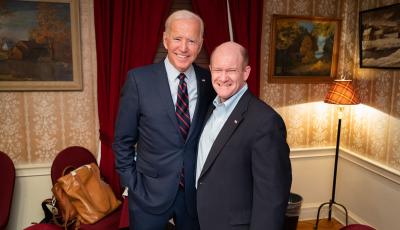
From the look of things, it is highly likely that the MCC will not risk its good reputation by financing Julius Maada Bio’s SLPP regime that stole the June 24, 2023 elections in Sierra Leone. In a joint letter addressed to MCC Chief Executive Officer Alice Albright, United States Senators Jim Risch (Republican – Idaho) and Chris Coons (Democrats – Del.) from the Senate Foreign Relations Committee voiced their concerns regarding Sierra Leone’s ongoing eligibility for a Millennium Challenge Corporation MCC compact. The letter dated November 27, 2023, highlighted the senators’ unease following Sierra Leone’s controversial elections in June 2023. (Photo: Senator Coons with President Biden).
WASHINGTON – US Senators Jim Risch (R-Idaho), ranking member of the Senate Foreign Relations Committee, and Chris Coons (D-Del.), yesterday sent a letter to Millennium Challenge Corporation Chief Executive Officer Alice Albright expressing concerns over Sierra Leone’s continued eligibility for an MCC compact. “We write to express concern over Sierra Leone’s continued eligibility for a Millennium Challenge Corporation (MCC) compact following the nation’s deeply flawed elections in June 2023,” wrote the senators. “While there may be compelling diplomatic and development reasons for moving forward with an MCC compact, we urge the board of directors to consider whether the benefits of proceeding at this point outweigh the reputational risk.”
“Democracy faces serious challenges in Africa and around the globe. The recent surge in coups and contraction of democratic spaces globally may have narrowed the pool of potential MCC partners, but that does not mean the MCC should lower its standards,” the senators continued. “Now, perhaps more than ever, it is essential that the MCC stay true to its foundational principles.” “We recognize that a compact of this size and scale may provide a significant point of leverage to incentivize the adoption of political and electoral reforms in Sierra Leone,” the senators concluded. “We urge the MCC’s Board of Directors to keep this in mind as they consider re-selecting, and ultimately signing, a compact with a country that is so clearly backsliding and has not sufficiently taken steps to reverse course.” The full text of the letter can be found here and below:
Dear Ms. Albright:
We write to express concern over Sierra Leone’s continued eligibility for a Millennium Challenge Corporation (MCC) compact following the nation’s deeply flawed elections in June 2023. While there may be compelling diplomatic and development reasons for moving forward with an MCC compact, we urge the board of directors to consider whether the benefits of proceeding at this point outweigh the reputational risk. The MCC was created for the sole purpose of reducing poverty in countries that demonstrate continuous commitment to democracy and good governance, economic freedom, and investing in people. Other countries are watching to see how the MCC will respond to well-documented democratic backsliding in Sierra Leone. Toward that end, a decision to re-select Sierra Leone at the December 2023 board meeting will likely have consequences for years to come. However, should Sierra Leone demonstrate credible and serious reforms and accountability processes, this could change.
Between 2016 and 2021, a $44.4 million MCC threshold program in Sierra Leone helped improve the delivery of water and electricity services in the greater Freetown area. It also helped drive reforms that enabled Sierra Leone to become eligible to develop a large-scale development compact in December 2020. The board re-selected Sierra Leone again in 2021, 2022, and 2023, citing steady and improved performance across the scorecard used to measure the country’s commitment to MCC’s foundational principles and eligibility criteria. This enabled MCC to commit an additional $11.97 million for the design of a $450 million development compact, focused on power generation and electrification across the country. Sierra Leone has one of the lowest levels of access to electricity (26 per cent) in the world, so there was no question that this compact would be truly transformational. (Photo: Senator Risch).

Unfortunately, the conduct of deeply flawed elections in June 2023 has called into question Sierra Leone’s continued commitment to upholding MCC’s eligibility criteria. According to domestic observation groups, “official results announced for the presidential election do not align with the true ballots cast at polling stations.” International election observation missions similarly expressed concern about the transparency of the vote tabulation process, politically motivated violence, and “significant logistical problems [that] hampered voting on election day,” among other issues. There is little doubt that these irregularities, once appropriately captured by the country’s scorecard, will push Sierra Leone into the pool of countries that fail to pass MCC’s Democratic Rights “hard hurdle” for eligibility. The board must therefore consider whether it is appropriate now to select and sign a $450 million compact with a country destined to fail its scorecard once the data on paper catches up with reality on the ground.
We recognize that a compact of this size and scale may provide a significant point of leverage to incentivize the adoption of political and electoral reforms in Sierra Leone. We therefore welcome the State Department’s effort to engage Sierra Leone’s leadership and opposition in dialogue that could pave the way toward accountability and electoral reform. This engagement, as well as the internationally-mediated dialogue between the government of Sierra Leone and the opposition All People’s Congress, is a positive step forward. Still, these lines of effort are not a remedy for the serious wrongs committed during the June 2023 electoral process. The recent military mutiny in Sierra Leone highlights the country’s fragile institutions and underscores the urgency for implementing promised democratic reforms.
Democracy faces serious challenges in Africa and around the globe. The recent surge in coups and contraction of democratic spaces globally may have narrowed the pool of potential MCC partners, but that does not mean the MCC should lower its standards. Now, perhaps more than ever, it is essential that the MCC stay true to its foundational principles. Sierra Leone will serve as an important test case of that commitment both here in Washington and overseas. We urge the MCC’s Board of Directors to keep this in mind as they consider re-selecting, and ultimately signing, a compact with a country that is so clearly backsliding and has not sufficiently taken steps to reverse course. We thank you for your attention to this matter and look forward to your timely response.
Sincerely,

Editorial
19 July 2026
ECOWAS Summit Update: Cocaine Bio is Scared of Handing the ECOWAS Chair to Senegal President Faye; Bio Prefers Anglophone to Francophone Successor!
19 July 2026
Commentary
19 July 2026
EBK’s Fake Freedom Won’t Distract EJ Win; His Arrest for Betraying Democracy Looms; Tinubu Happy to See EBK’s Back; Hope He Returns Sooner to Face Citizens
19 July 2026
Other News

18 August 2026
18 August 2026
Bio’s Greatest Worry Now is How to Stop His Son-in-Law Jos Leijdekker from Arrest; Bio Would Have Given Up Had Omar Sheriff Not Been in the Picture
17 August 2026
17 August 2026
Bitter Lessons Await Bio as He Stupidly Prepares SLPP Militias, Hezbollahs and Hamas to Fight Foreign Forces Poised to Remove Him Forcefully and Quickly

15 August 2026
15 August 2026
Global Partners Boycott of Parliament Clearest Sign to Signal End of Illegal Bio’s Era; First Time Foreign Envoys Snubbed Parliament; Bio is a Dead Man Walking

14 August 2026
14 August 2026